Untitled Document
 
Untitled Document
Honda RS 250 GP 1997'
 
145900 visitors
1 visitors online
4563089 hits
Website online since 02/2006

Throttle Compilation 1
Throttle Compilation 2
1st time alive, result: 1 leg injured
Piston: WISECO
Cylinder: GP pedigree, new timings passages reshaped for higher gas flow
Cylinder head: new head volume and squish angle for 13.7:1 corrected CR
Radiators: 2 Yamaha DT 125R radiators
Spark: NGK B10EG
Exhaust valve: YPVS locked, completely opened.
Reeds: VFORCE
Carburetor: Mikunis TM 38mm bored to 41mm.
Electric part: Yamaha TZR 50 with new variable ignition map LuFo CDI unit.
Air Filter: doesn't use any kind of air filter
Clutch: reinforced, NEWFREN springs and ferodo clutch disks.
Silencer: LUFO chromed steel
Exhaust system: LUFO system
Oil: Direct mixture in the deposit, 2%
Transmission: 16 - 42 and 17 - 42 with 420 chain.
Gearbox: Yamaha TZR 125
Engine maximum rotation in charge: 12 850 rpm sub-rotation
HorsePower (crankshaft): Over 50 hp
HorsePower (rear wheel): Over 40 hp
Top Speed: REAL 170 km/h (16 - 42) & REAL 180 km/h (17 - 42)
Losses between Gears (%): - | 56.3% | 32.45% | 19.74% | 14.29% | 9.09%
Crankshaft - ConnRod Attack Angle: 76.17º
Linear Piston Movement : 22.5 meters/second
Number of Explosions per second : 217
Wheels: Grimeca Honda NS1, front 2.5' and 3.0' rear.
Tires: Dunlop slick 90/70x17' front and Dunlop slick 115/70x17'.
Brakes: Yamaha RD 350 brake calipers, double NS1 rotors, rear Brembo caliper with NS1 rotor.
Braking system: stainless steal.
Suspension: Front Gilera Chrono 125 inverted suspension.
Steering Damper: 3 possible regulations.
Frame: stock modified.
Swingarm: Honda XR 600 alloy polished.
Chain: 420
Fenders: Rear Honda CR 250, front Acerbis Supermoto, UFO headlight.
Stop light: LEDs.

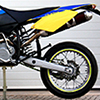
The purpose of this hybrid prototype is, to create an outstanding 2-Stroke supermotard, uniting a supermotard with a pure GP 2-Stroke engine.
So, we picked up our Honda CRM 50 chassis whose weight is equivalent to a 125cc trail like Honda CRM 125 or Yamaha DT 125R, with an approached weight of 100 kg, and assembled the Yamaha DTR 125 engine with TZR 125 parts.
The only Yamaha DTR 125 parts in the engine are the crankcase, the crankshaft and the cylinder. The Yamaha TZR 125 parts later installed are the gearbox sprockets and the cylinder head.

After the engine tuning made on the Honda CRR, the stock engine with only 28 hp at crankshaft, started to debit near 55 hp at the crankshaft.

The power increment is substantial, we're talking about 27 hp, almost the double of the original/stock output power at crankcase (about 96.4% of output power increase in this engine, in a high revy way with the maximum power placed on the last band of rotation, just like it happens on the 2-Stroke MotoGP bikes, to maximize the real top speed and accelerations in medium/high velocities).

On the other hand, the chassis of the Honda CRR behaves very well in curve, had to the fact we use a back and front slick Dunlop tire 115/60x17' and 95/70x17', and a good reduction of the height of the front suspension (compared with stock CRM 50), the braking is guaranteed by the double brake disc with 250mm each, that allows an impressive and awesome braking power but also progressive.

To still relate, that all the Statistical Tables about Gearboxes, Statistic Tables with Real Speeds in Each Gear and the relative information about the ConnRod-Crankcase Attack Angle, had been calculated from the recent software developed for the RacingSM, called RacingSM Software of 2-Stroke Preparations v1.3.

Now we pass to the study of the Honda CRR (TZR 125 gear box), from which we can take many conclusions about the performances and losses between gears in a percentual way.
So, we now give the graphic relative to the Jumps/Losses Between Gears (%) for the Honda CRR:
 

As we can see through the Graph "Jumps Between Gears (%) Honda CRR", that the gearbox is very nice for top speed, the first gears are somehow long, then the 3 last ones are very short. As we can comprove by the Graph, the Jump/Loss between 5th and 6th gear is 9.09%, a good value for this kind of engine tuning, as we know in street bikes/GP bikes, the gearboxes are very close ratio to prevent breakings between gears.

Now we're going to present the thematic of the Real Velocities in Each Gear. Relatively to the top speed, it's necessary to have in count some aspects:


The Yamaha DT 125R completely stock (internal engine, exhaust, carburation, etc) only revs to a maximum near 9 500 rpm, making real 121 km/h in 6th gear.
The Honda CRR prototype, with it's engine tuned by LuFo, with Grimeca 17' wheels and reving to a garanteed real 12 400 rpm and 16 - 42 secondary transmission, makes real 170 km/h.
In a percentual way, the velocity gains in each gear were:

1st gear: 34,99 to 54,5 km/h -> 56%
2nd gear: 52,86 to 85,8 km/h -> 62%
3rd gear: 70,25 to 113,7 km/h -> 62%
4th gear: 86,81 to 136,2 km/h -> 57%
5th gear: 103,69 to 155,6 km/h -> 50%
6th gear: 121,14 to 169,7 km/h -> 40%

The Honda CRR prototype is making high real velocities, near 120 in 3rd gear, this velocity is Yamaha DTR 125 completely stock real velocity in 6th gear!
We can think, this secondary transmission is too long, but on the contrary, the spontaneous aceleration of the CRR is comparable to a Honda CR 250 2002' and so many other bikes, that acelerates like hell, also, some videos made by us, comprove that the Honda CRR prototype with secondary transmission 16 - 42 uses 6th gear in a short distance, near half a kilometer.

We think the main objectives on the creation of this CRR prototype were achieved, since we powered an Yamaha DTR 125 engine, that has 28 engine hp stock, to a near 55 engine hp with some reliability and a great powerband (from ~9 000 till ~13 000 rpm sub-rotation, it's a near 4 000 rpm band delivering great power & torque).
On the other hand, the joy of driving this prototype is awesome, the chassis was a well-done job by José Fernandes and the parts being used were well chosen, the Honda XR 600 swingarm has more lenght than the original Honda CRM 50 swingarm, with more rigidity, this improves the distance between axis and manageability.
The slick tyres also do their job, by giving more tack and security to the driving, and the front inverted suspension from the Gilera Chrono 125 with it's reduced lenght, provides a great rigidity.

Also, to garantee better driving, it was installed a steering damper with many configurations


All Contents Copyright © 2002-2007 RACINGSM - All Rights Reserved